sLLM
Table of Contents
sLLM, or “slime Large Language Model,” is a closed-circuit instrument that puts a living slime mould (Physarum polycephalum) and a large language model into a recursive exchange of signals with each other. The organism is read through electrodes, the model answers with light, and the organism reconfigures itself over the following minutes to hours in ways that change what the model sees next. The sound and image of the piece are rendered afterwards from the recorded log of that exchange rather than live.
Related: An AI Married a Slime Mould
How it works
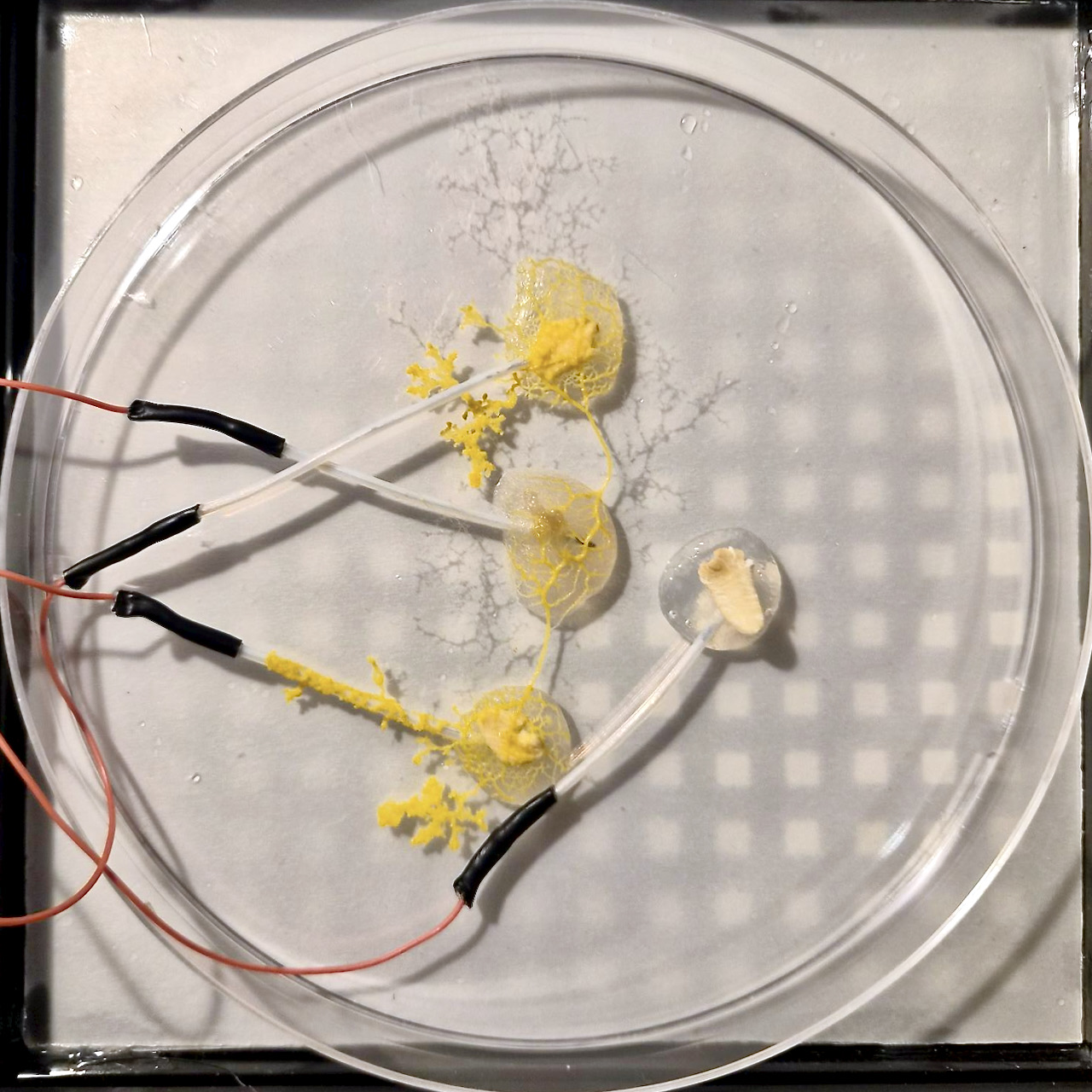
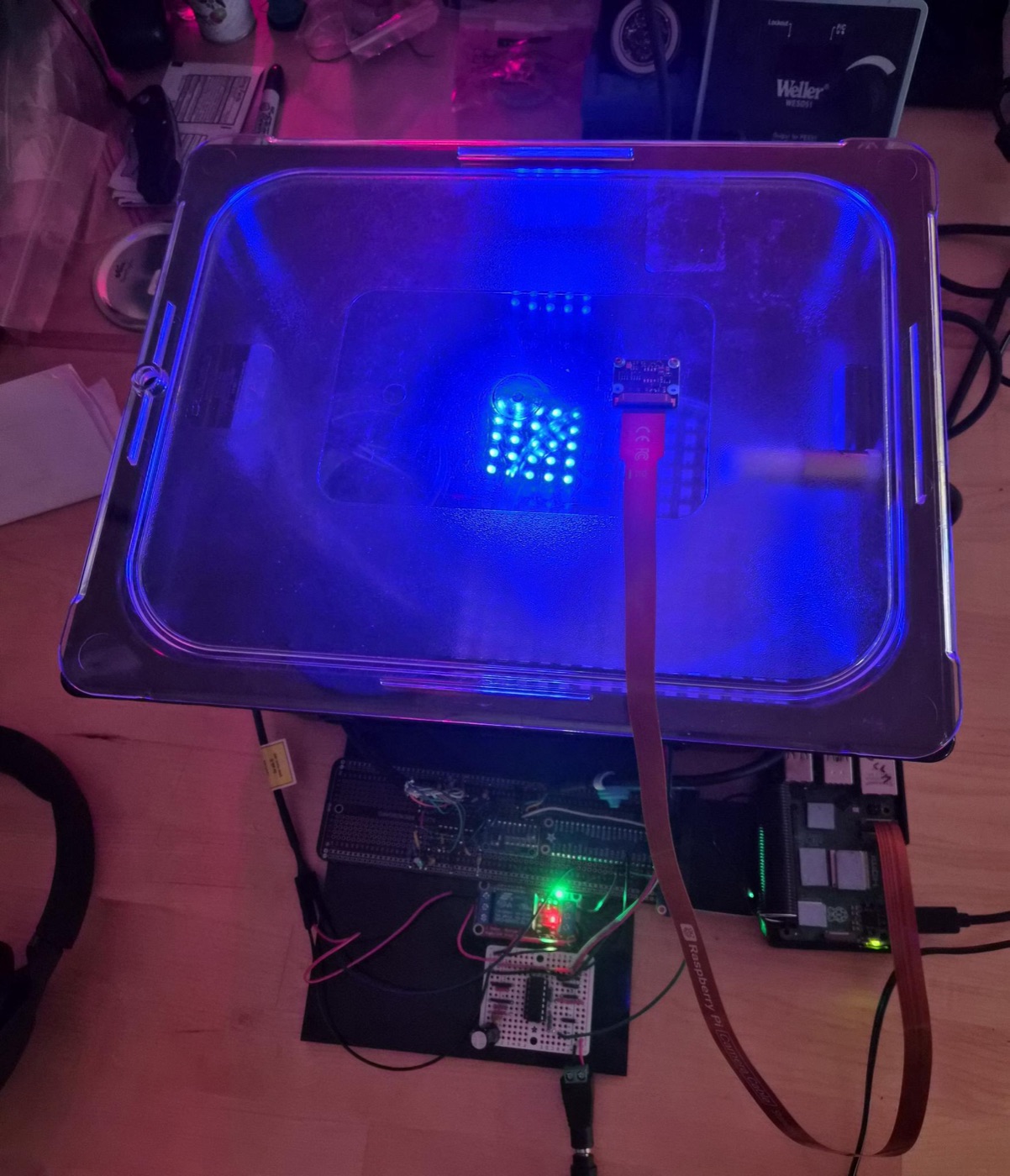
A Physarum plasmodium grows across agar islands in a sealed chamber, and electrodes under the islands record its extracellular potential once per second against a common reference. A reduction layer turns the preceding half hour of that recording into four quantities, which are the oscillation period, the amplitude, the phase lag between electrodes, and the baseline drift, and passes them to a language model running locally. The model does not receive these on a schedule; a new reading reaches it only when the state has changed by more than the measurement can resolve, or when the delay the model last asked for has passed. The only thing the model can do in response is illuminate one of nine regions of the chamber with blue light, which the organism avoids, and it is never told whether doing so had any effect.
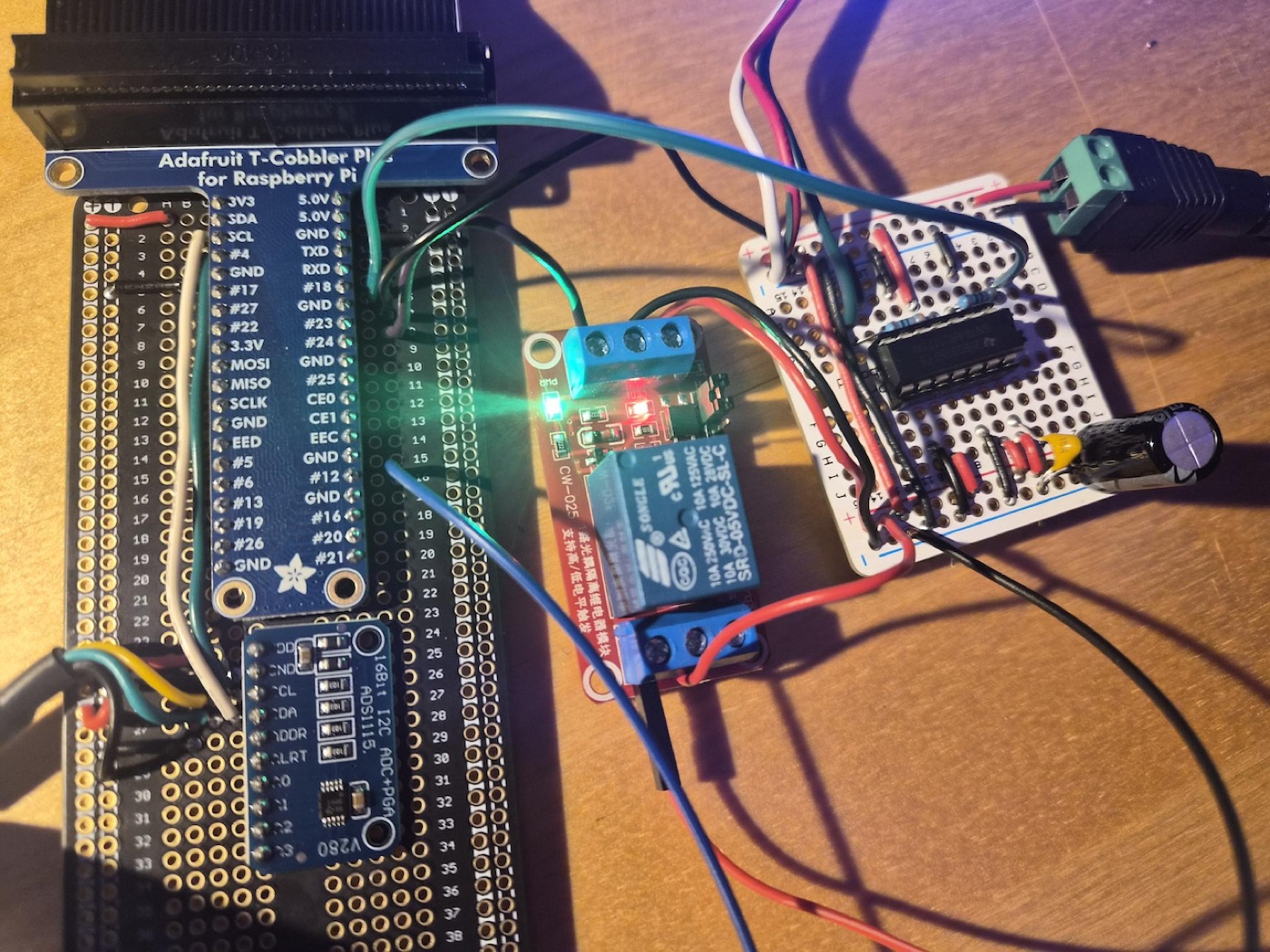
Sound in the piece comes from the organism and image comes from the model. The phase relationships between the three electrodes set the coupling strengths in a bank of CMOS oscillators tuned in just intonation, so that when the organism is coherent the bank locks and holds nearly still, and when the lags drift or reverse it comes apart into beating before re-locking somewhere new. A CD4046 phase-locked loop sits in the bank as a listener of its own, since its whole function is to stay in step with something, and it can be heard straining, losing its grip and catching again. The image is two overlaid gratings whose relative spacing is driven by the model’s per-token uncertainty, so that moiré interference does for the model what beating does for the organism. I have avoided mapping anything to magnitude in either case, because a magnitude mapping is a code a viewer learns in thirty seconds; what both the sound and the image respond to is whether things stay in register with each other.
What it is not doing
The piece does not translate between the organism and the model, because there is no dictionary between the organism’s electrical activity and natural language. Before I built anything else I built the layer that refuses to report anything it cannot distinguish from noise, and I tested it against synthetic data with planted events so that I would know what the model was confabulating and what the reducer was throwing away before anything in the chamber was alive.
Nor is it staging a conversation. Physarum registers blue and UV light, chemical gradients, humidity, temperature, contact, and the stiffness of whatever it is sitting on, and it has no receptor for a language model. It can be shaped by one, but it has no way of registering that one exists, and the model for its part receives the organism as four numbers. There is no symmetry between the two. The model can adjust the zone, intensity and duration of the light and nothing else, while the structure, the rules and the goals of the system are mine. I am not interpreting the slime mould or speaking for it so much as sampling it up into the band of human perception and presenting that, which is what places the work in art rather than science, even though it borrows scientific practice where it needs to in the form of empty-chamber controls, a measured noise floor, and sham blocks in which the model’s actions are logged but never applied.
Why these two systems
I put these two together because neither of them has a part inside it that is in charge of the rest. Physarum is a single cell with no nervous system, where different regions contract slightly out of step with one another and the direction it moves is a consequence of that timing, and a language model has no single place where meaning is stored, since every word it produces comes from all of its weights at once. Both also have more intelligence ascribed to them than can be demonstrated. We want to believe that Physarum can solve mazes and learn patterns and be built up into a living computer, in the same way that we want to believe AI can possess understanding and creativity, and in both cases what can be observed is behavior that approximates those things while the words attached to the observations carry most of the weight.
Current status
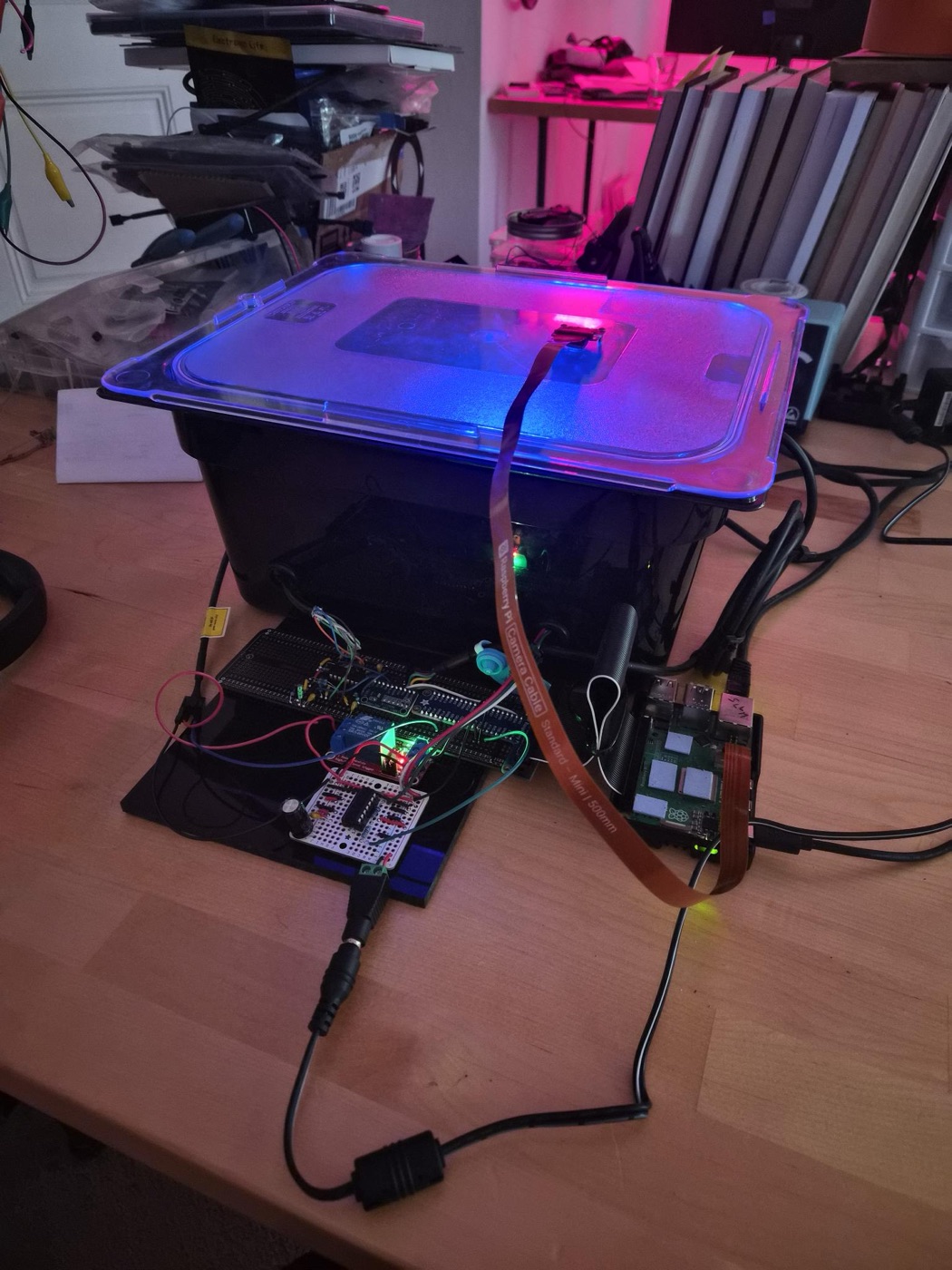
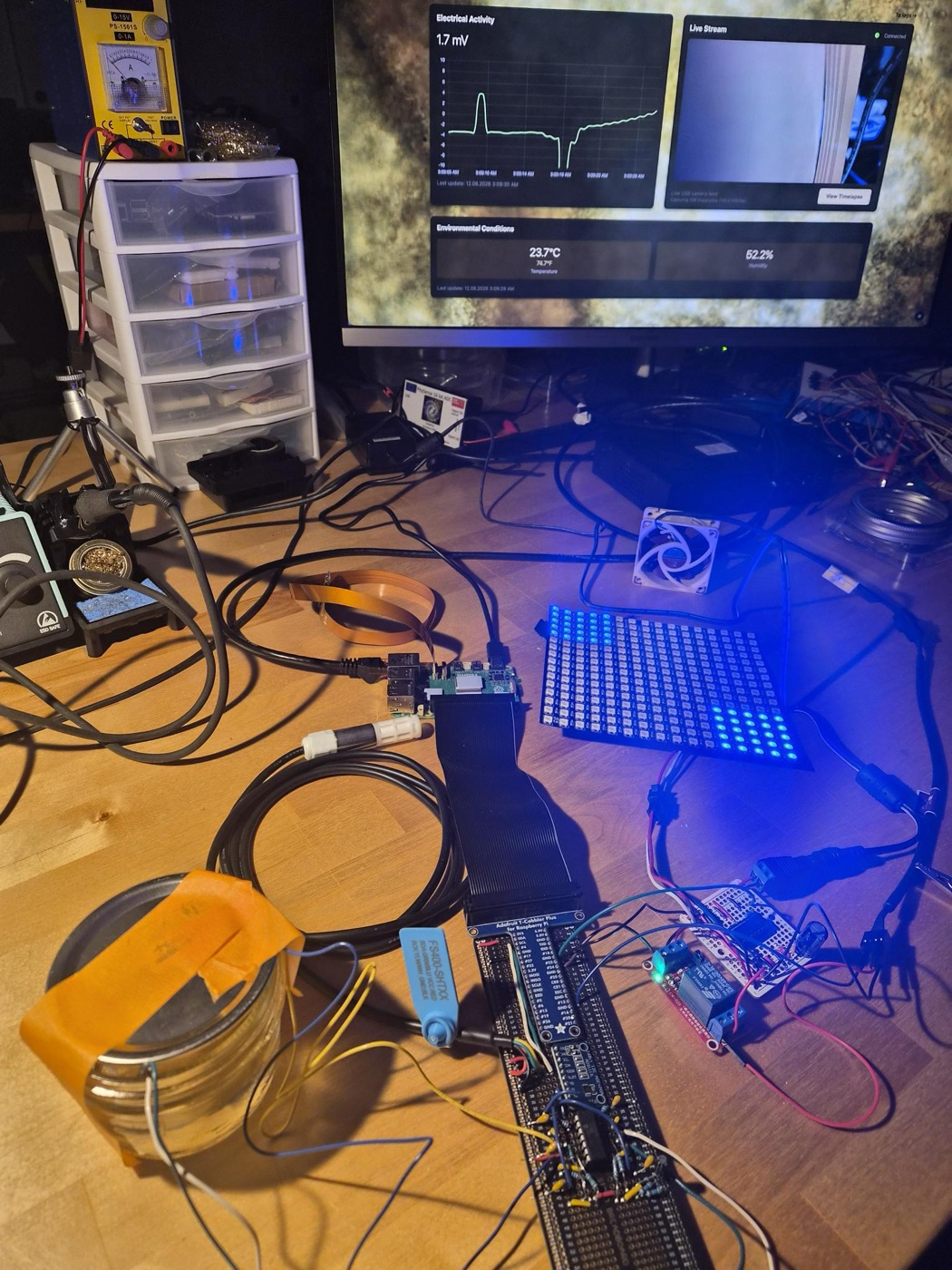
The instrument is built and running on my desk, with a sealed chamber over a 16×16 LED matrix, three silver/silver-chloride recording electrodes plus a reference, a 1 Hz analog-to-digital converter, humidity and temperature logging, and a camera photographing the dish every five minutes. Over the summer 2026 growth runs the organism reached all three electrodes, and each one, once reached, shows a voltage rhythm of roughly two minutes that is absent on the same probes during an empty-chamber control day and absent again after the organism is removed. The next test is stimulus and response, which means changing the blue light with the organism still connected and seeing whether the rhythm changes with it.
The sound side of the work, patching the organism into the oscillator circuits and giving the model a voice that is audible rather than typed, is the focus of a 2026 residency at Stochastic Labs in Berkeley.
Related projects
Physarum Controlled Oscillators · Physarum Topologies · Modeling Utopia with Slime Mould · Felted Signal Processing